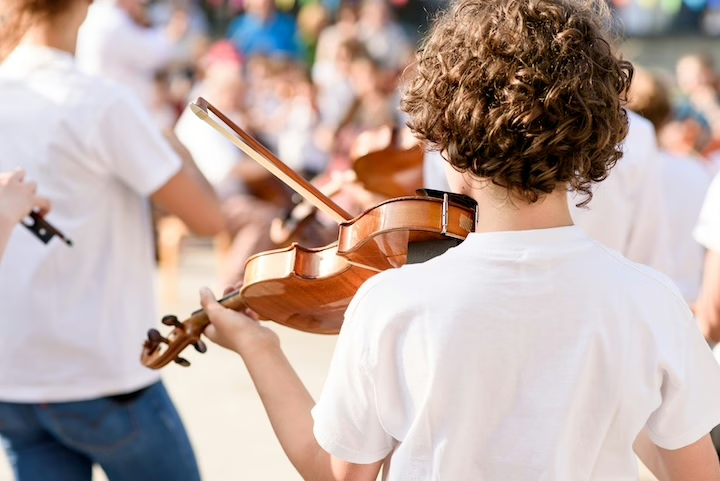
Sometimes kids absolutely love performing in group classes, at recitals and for their family. But for other children, the idea of being in the spotlight may be a more intimidating or stressful part of music lessons. They may wish they could perform and participate with the other children, but fear is a wall that completely blocks their access to these opportunities.
Acknowledge your child’s feelings. If your kiddo feels scared, stressed or worried about performing, be sure to acknowledge and honor their feelings. The idea of “throwing them into the pool so they can learn to swim” could escalate their anxiety or even be traumatic. Instead of throwing them into full emersion to face their fears, consider ways that you could allow them to dip their toe in, wade in, and then jump in when they are ready. This will also allow them to trust you to believe and support them in the future.
Start small. If a child is not ready to participate in a performance with an audience, look for baby steps on a smaller scale. Perhaps you could hold a first “recital” performance with only the parents and teacher present. For a young child, they could also bring some stuffed animals to sit in chairs and be part of the audience. The kiddo could attend a rehearsal with the accompanist but that basically serve as their performance. Wait to have them perform on stage. Let them attend and see a performance to get a better idea what it would be like the next time when they participate. Make a video of them performing and allow them to share it with friends and family, if they are not ready to perform live.
Be a detective. If you read my blog, you have heard this before: Psychologist Dr. Ross Greene’s premise is that children do well if they can. Behavior is communication of an unmet need or lagging skill. We can follow the behavior pattern like a trail of breadcrumbs to lead us to the need. During lessons, be sensitive to who is in the room. When the child is more at ease, try to take notes of what went well and if you can make any connections to the why it went well. When a lesson or performance is more stressful, try to observe what is difficult for your child. Was there a certain point when they became especially anxious? What was happening at the time?
Additional Ideas. I won’t invite a prospective family to observe the lesson of a child who is anxious about performing. Ask the teacher to “bury” the child in the middle of the recital program. This way, they can see a couple people perform before their turn, which helps them know what to expect. Then they can go and be done and feel more relaxed for the rest of the concert. A teacher or another student could play along with your child. Playing with someone means they are not alone with the whole audience staring only at them. Their sound is blending with the sound of someone else. That can really be comforting. It also allows for body doubling, which is a scaffold where just having another person present makes completing a difficult task more manageable. A parent or family member could play with them. Or, a parent could perform separately in the same recital, modeling how they can try something new and do a brave thing. Avoiding a lot of eye contact may allow the child to feel more at ease to perform. If you notice that ongoing eye contact makes your child nervous, could you talk to the teacher about it? That brings up another point: is your child’s teacher collaborative and willing to flex to support your child’s needs? If so, that is wonderful. If not, then you may want to consider whether this teacher is the right fit.
It is okay to fail. Many times, I believe that performance anxiety can be linked to perfectionism. If this resonates, you could look for ways to help your child release their expectation of being perfect. For one, make sure that you and the teacher focus praise on the child’s effort and not on the end result. Model making mistakes at home and handling them well. Let your child see you make mistakes. It helps if the teacher can also model making mistakes. Explain to your child how the neural synapses in their brain fire and they learn when they make mistakes. If they make no mistakes, that means they are not being challenged and the material is too easy. Be careful about phrases like, “Always do your best.” Gifted and neurodivergent kids can be black-and-white thinkers who may take that seriously. In reality, it is not sustainable to do your best at everything all the time. You don’t need to win an award for how you tied your shoes, for instance.
Implement appropriate accommodations. These are similar to what you might see in a 504 for a public school classroom. (In fact, if your child has a 504 or IEP, perhaps there are accommodations from that you could share with the teacher.) Even if you don’t have a 504, it is ok to request accommodations simply based on observed needs. As the parent, you are the expert on your child. Accommodations may include anything I’ve already suggested, but here are some standard ideas:
- In a group setting, only call on the child or pick the child in a way that singles them out when they volunteer.
- Preferential seating. In music settings, this could mean placing the child near a perceived safe person, such as the teacher, or next to a friend.
- The child could have a hand signal to let the teacher know they need to take a break and walk away for a minute. There could be an established plan, such as that they get a sip of water from their water bottle.
- In a case of extreme anxiety and in the early stages, it could be that the child needs to be able to go with their parent to sit in the car.
- If an event is a certain duration, perhaps they can have permission to stay for half the time. (And baby steps towards stretching that to the whole time.)
- They have permission to attend and observe for a season before participating.
- They get paired for anything performance-related with a buddy rather than alone.
- An accommodation can be that the teacher uses praise around effort and not results. (This benefits everyone!)
- Extrinsic rewards when a child already is struggling with a task may backfire and add more pressure.
Remember that many of these supports or accommodations can be used as scaffolds, meaning that they are needed for a time but not forever. As the child warms up to the situation and is ready to try new things, scaffolds can be discarded. Aim for baby steps instead of leaps.
You’ve got this.
Christina
Leave a Reply